
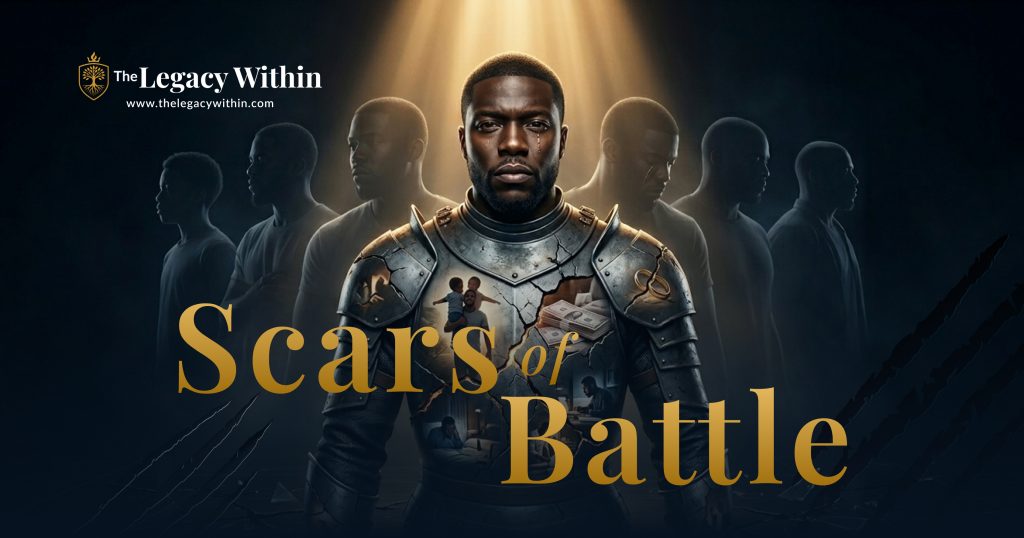
The Scars of Warfare That You Never Intentionally Entered
Welcome back to another edition of The Legacy Letter.
On a grey Saturday morning, just after dawn, a man named Jonah stood in front of his bathroom mirror, shirt off, toothbrush in hand, staring at a scar that ran diagonally across his ribcage. He had seen it a thousand times, but that morning it felt louder, like it was trying to speak.
It was not a dramatic scar. Not the kind that comes with a heroic story. It was small, pale, almost forgettable. The kind of scar you could hide easily. The kind of scar most men carry somewhere, on their bodies, in their minds, or deep in their spirit.
His son, half-asleep and dragging his blanket behind him, wandered into the bathroom.
“Daddy… what’s that line on your side?”
Jonah froze.
He could have said, “Oh, nothing son.”
He could have changed the subject.
He could have brushed it off like men often do.
But instead, he knelt to his son’s level and said,
“It is a scar. It reminds me of something I survived.”
His son blinked slowly.
“Did it hurt?”
Jonah nodded.
“Yes. But it healed. And now it helps me remember who I am becoming.”
The boy touched the scar gently, as if it were a story carved into stone.
Then he whispered, “I hope I get one too.”
Jonah laughed softly.
“No, son. You do not want scars. But you will get some. Everyone does. What matters is what you do with them.”
And in that moment, Jonah realised something he had never said out loud:
Scars are not proof of damage. They are proof of healing.
The Scars You Don’t Show
Every man has scars.
Some are visible.
Most are not.
There are the scars from childhood, the words that cut deeper than any blade,
the absence that felt like abandonment,
the expectations that crushed more than they built.
There are the scars from adulthood, the job that broke your confidence,
the relationship that fractured your trust, the failure that made you question your worth.
And then there are the silent scars, the ones you never talk about,
the ones you pretend do not exist, the ones you learned to hide behind competence, humour, or busyness.
But here is the truth:
A scar is not a wound. A scar is a wound that has healed.
So why do so many men treat their scars like shame instead of evidence of survival and healing?
The Battle You Never Chose
Most men do not choose their battles. They inherited them.
You did not choose the father who couldn’t say “I’m proud of you.”
You did not choose the environment that taught you to be strong but never safe.
You did not choose the pressure to perform, provide, and pretend.
You did not choose the emotional armour you had to wear just to make it through.
But you fought anyway.
You endured anyway.
You kept going anyway.
And the scars you carry today are not signs of weakness.
They are signs that you refused to die in the place where life tried to break you.
The Legacy Hidden in Your Scars
Here is the part men rarely understand:
Your scars are part of your legacy.
Not because they show what hurt you, but because they show what shaped you.
A scar says:
“I’ve been through something.”
“I’ve learned something.”
“I’ve survived something.”
“I’m still here.”
Your children do not need a perfect man.
They need a healed man.
A man who can say,
“I’ve been wounded, but I did not stay wounded.”
Because when a man hides his scars, he passes on his wounds.
But when a man honours his scars, he passes on his wisdom.
The Courage to Look at Yourself
Most men avoid their scars because they fear what they will feel.
But the moment you face them, something powerful happens:
You stop being defined by what hurt you.
You start being defined by what healed you.
You stop running from your past.
You start rewriting it.
You stop pretending you’re fine.
You start becoming whole.
And that is the beginning of legacy
not perfection,
not performance,
but healing.
A Challenge for This Week
Sit with this, not as judgement, but as truth:
Which of your scars have you been hiding from yourself?
And then ask:
What would change if you saw them not as reminders of pain, but as reminders of strength?
Because the men who leave the deepest legacy are not the ones who never bled.
They are the ones who learned how to heal and then taught others how to do the same.
Remember that a scar is not a wound. A scar is a wound that has healed.
Coach T, The Legacy Decoder